Internal insulation has a reputation for being tricky. That reputation usually refers to installation. The real risk lies elsewhere: poorly designed internal insulation can do more damage to the existing building than insufficient insulation.
When internal insulation isn’t a choice
In retrofit projects, internal insulation – or internal retrofitting – is most often the only option in these situations:
- a listed façade or one in a protected area, where external insulation is ruled out;
- a party wall, which cannot be reached from outside;
- balconies, cornices or mouldings that prevent continuous external insulation;
- a budget split into phases, which means moving forward room by room without touching the envelope.
In all these cases, the question is no longer whether to insulate from the inside. It is how to do it without damaging a wall that, until now, was in good health.
What insulation changes in the existing wall
Before insulation, the masonry is heated from the inside. It stays relatively warm, and the moisture it takes in escapes on both sides.
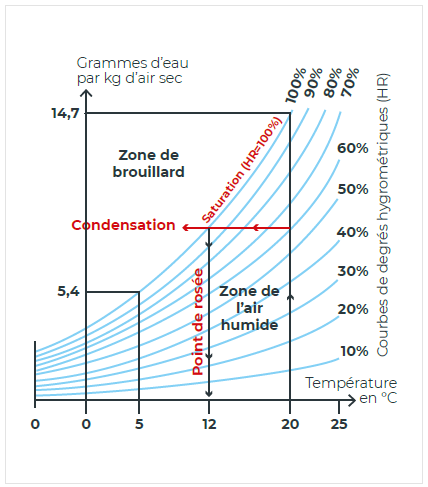
Once the insulation is installed on the inside, the old wall finds itself on the cold side. Its temperature drops, and the dew point moves towards the interface between the insulation and the masonry. Water vapour migrating from the heated interior then meets a cold surface. If it can’t continue on its way, it condenses. This is interstitial condensation: it goes unseen for months, until the day the plaster comes away or an embedded beam starts to rot.
 That’s only half the problem.
An old wall isn’t only wetted by indoor vapour. It also receives rainwater on its outer face and, often, rising damp from below. This moisture must be able to escape, and part of the drying happens towards the inside.
Why a vapour barrier doesn’t solve the problem in historic buildings
The classic answer to interstitial condensation is the vapour barrier: vapour is blocked on the inner side and no longer reaches the cold zone. In a well-designed new build, this logic works.
In historic buildings, it turns against the wall. The vapour barrier stops vapour getting in, but it also stops the moisture already present from getting out. Water brought in by rain or from the ground stays trapped in the masonry, behind an almost airtight layer.
Workmanship also has to be taken into account. On irregular walls, with embedded joists and corners that are rarely square, a perfectly continuous vapour barrier is the exception. The slightest discontinuity concentrates the vapour flow at one precise spot – often the worst one.
What a capillary-active material does differently
Capillary-active materials approach the problem from the other direction. Instead of blocking moisture, they manage it.
They have two properties, which need to be distinguished. First, they are vapour-open, which is measured by the µ factor. The IsoHemp hempcrete block has a µ of 2.8, compared with around 60 for a conventional petrochemical insulation material. Second, they temporarily absorb excess moisture and redistribute it. The hempcrete block can store up to 12 L/m³ and release it according to ambient conditions.
The wall therefore no longer needs to be “protected” by a vapour barrier. It keeps drying continuously, just as it did before insulation.
“Not having to install a vapour barrier really simplified the site. The hempcrete block naturally regulates humidity, while guaranteeing a healthy, breathable wall.”
A breathable insulation material isn’t enough on its own to make the wall breathable, though. What counts is the complete build-up, and this is checked using the Sd value of each layer. For a non-ventilated wall, the Sd on the inner side must remain at least five times higher than the Sd on the outer side. This reasoning is explained in detail in our article on breathable materials.
Where the choice of material matters most
This approach primarily concerns historic buildings: brick, stone, rammed earth, timber frame. The risk increases further on a north-facing façade, which dries little, and where there is rising damp. In these configurations, the hygric behaviour of the insulation counts as much as its thermal resistance, and the designer’s liability is directly at stake.
The finish matters too. A hempcrete block wall finished with lime, clay or gypsum plaster remains vapour-open. Covered with a film-forming paint, it loses a large part of this capacity, even though the layer is only a few tenths of a millimetre thick.
In historic buildings, insulating isn’t about adding a layer to the wall.
You are entrusting it with a layer that has to work with it.
Are you an architect, design office or contractor?
The key is to check at the design stage that the build-up of layers respects the Sd ratio. At IsoHemp, we have the tools and the expertise to support you with this.