What “breathable” actually means.
A breathable material lets water vapour pass through the wall without obstructing it. This property is measured by the µ factor, which expresses the material’s resistance to water vapour diffusion: the lower the figure, the more permeable the material.
µ depends on the nature of the material, not on its thickness: a hempcrete block therefore has the same µ at 12 cm as at 36 cm.
| µ 2.8 IsoHemp hempcrete block |
µ ≈ 60 Polyurethane, extruded polystyrene |
The IsoHemp hempcrete block has a µ of 2.8. A conventional petrochemical insulation material (polyurethane, extruded polystyrene) sits at around 60.
But µ alone tells you nothing about a real wall, built at a precise thickness. For that, we use the Sd value. Unlike µ, it characterises a layer as it actually exists on site – a material at its real thickness.
An example makes the difference tangible: a 36 cm hempcrete block wall (µ = 2.8) has an Sd value of about 1 m. A coat of film-forming paint, on the other hand, can exceed an Sd of 10 m with a thickness of just a few tenths of a millimetre.
An entire breathable wall can therefore end up blocked by a layer a thousand times thinner than itself. This disproportion explains why Sd, not µ, is the reference in standard thresholds: it is the only indicator that takes into account both the nature of the material and its actual thickness.
A “breathable” wall is therefore judged by the Sd of each of its layers, which add up: what counts is the complete wall, never the insulation on its own. For a non-ventilated wall, the Sd on the inner side must remain at least 5 times higher than the Sd on the outer side; below that, the vapour migrating from the inside to the outside risks condensing within the thickness of the wall. DIN 4108-3 sets the vapour-tightness threshold at an Sd of 1,500 m.
 Two errors come up regularly in technical documents: giving an Sd value without stating the thickness, or comparing a µ with an Sd as if they were the same quantity.
Breathable and capillary-active: a distinction worth knowing.
Designing breathable insulation starts with these two figures, µ and Sd, but doesn’t stop there. Not all breathable materials behave the same way when faced with moisture. Some simply let vapour through; others, known as capillary-active or hygroscopic, can also temporarily absorb excess moisture and then redistribute it.
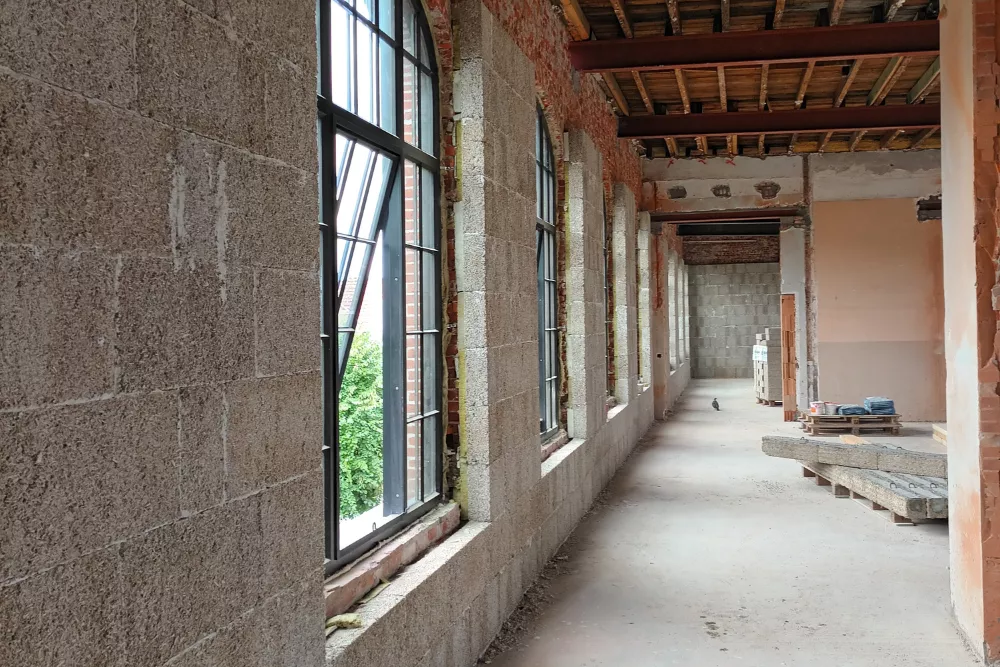
The IsoHemp hempcrete block falls into this second category: it can absorb up to 12 L/m³ of water vapour and release it naturally according to ambient conditions. This behaviour removes the need for a vapour barrier, which also simplifies installation on site.
“
We were immediately drawn to this material. It tells a completely different story compared to conventional insulation.
Why this parameter determines the durability of the wall.
With internal insulation, water vapour naturally migrates from the warm inside towards the cold outside. If the wall blocks this passage – vapour barrier, impermeable plaster, film-forming paint – the vapour risks condensing where the insulation meets the wall. This is known as interstitial condensation. When it occurs, it often stays invisible for several months before showing up as the damage described at the start: plaster coming away, timber elements rotting, mould developing.
A breathable material limits this risk by letting vapour circulate. A capillary-active material goes further, by managing moisture rather than simply trying to avoid it – which is the whole point of the distinction made above.
In a well-designed recent building, insulation with a vapour barrier can work without any problem. In historic buildings (brick, stone, timber frame), on north-facing façades or where there is rising damp, the risk is significantly higher, and the designer’s liability is at stake. Applying a blocking layer (vapour barrier, impermeable plaster or paint) to this type of building often ends up creating the very problem you are trying to avoid. This case calls for a specific approach: read our dedicated article on internal insulation in historic buildings.
Expert advice for the design stage
A wall’s breathable performance is also a question of finish. The hempcrete block works naturally with mineral plasters – lime, clay, gypsum – because all these finishes breathe with it. To get its full potential, it is best to think about this at the preliminary design stage rather than coming back to it once work on site is well under way.
Are you an architect, design office or contractor?
The key is to check at the design stage that the build-up of layers respects the Sd ratio. At IsoHemp, we have the tools and the expertise to support you with this.