Phase shift.
Phase shift measures the time a thermal wave takes to cross a wall, from the external face to the internal face.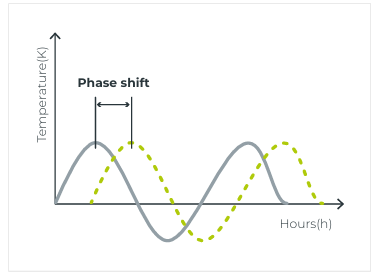
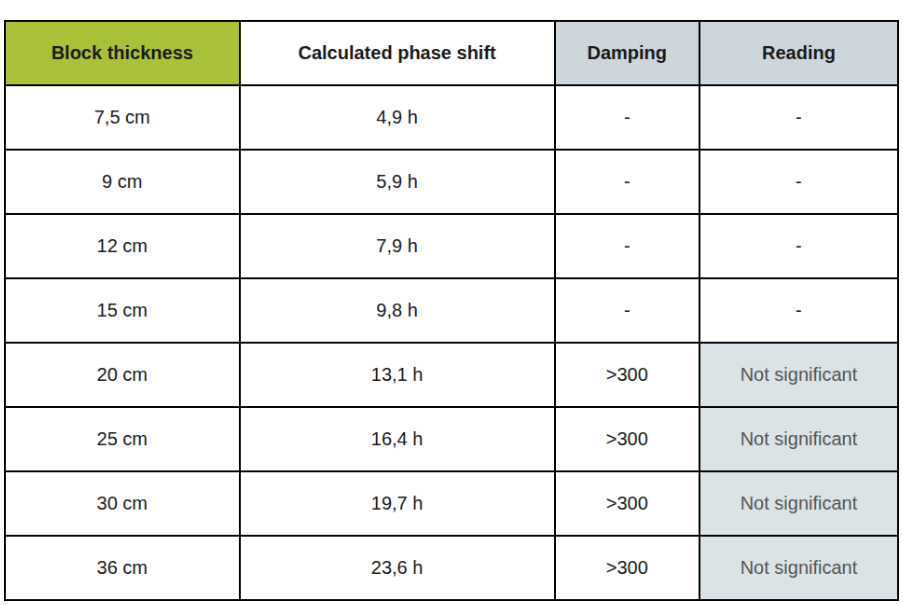
Across the IsoHemp block range, the calculated values run from 4,9 hours for the 7,5 cm block to 23,6 hours for the 36 cm block. Logically, the longer this time, the longer external heat takes to be felt inside, a useful benchmark, but one that stops where damping takes over.
Damping.
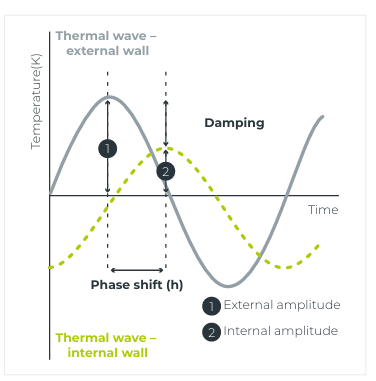
Damping measures something else: the reduction in amplitude between the external temperature and the internal temperature.
A wall with strong damping does not only delay the thermal wave, it attenuates it. And this is exactly what happens from 20 cm of thickness onward: on the 20, 25, 30 and 36 cm blocks, damping exceeds 300 %.
At this level of attenuation, the calculated phase shift values (13,1 h, 16,4 h, 19,7 h, 23,6 h) lose their meaning: the thermal wave is so flattened that it no longer exists strongly enough on the internal side for a time lag to have any physical reality. This is exactly what the IsoHemp summary table states: these phase shift values are not significant given damping above 300.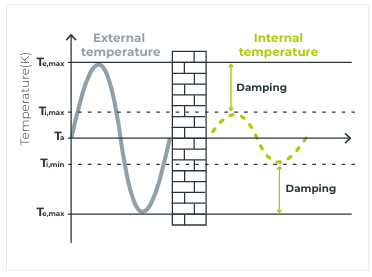
Phase Shift and damping, an inseparable pair.
So the figure is not wrong, it simply has nothing left to compare itself to.
A wall with strong damping does not only delay the thermal wave, it attenuates it. And this is exactly what happens from 20 cm of thickness onward: on the 20, 25, 30 and 36 cm blocks, damping exceeds 300 %.
At this level of attenuation, the calculated phase shift values (13,1 h, 16,4 h, 19,7 h, 23,6 h) lose their meaning: the thermal wave is so flattened that it no longer exists strongly enough on the internal side for a time lag to have any physical reality.
This is exactly what the IsoHemp summary table states: beyond 20 cm, phase shift values are not significant given damping above 300.
In practice.
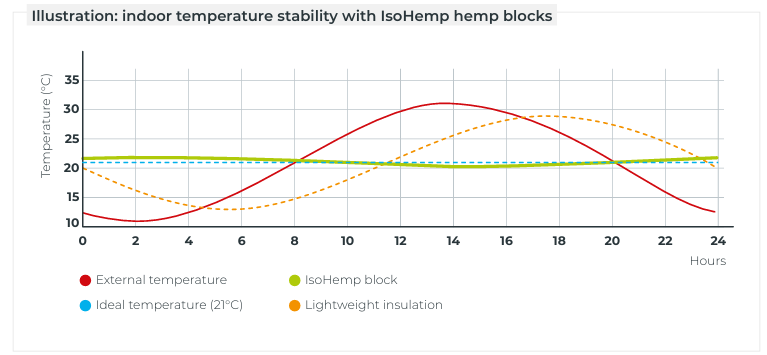
In practice, this means an internal temperature that stays stable with no peaks, even on the hottest days: the peak of external heat never manages to cross the thickness of the wall with any measurable intensity. This stability, combined with the material’s own insulation performance (λ = 0,071 W/mK), helps cut heating and cooling needs by up to 70 % over the year.
A question that remains open.
One question remains, and it is worth a detour: why does the hempcrete block behave this way? The answer lies in two lesser-known physical quantities, diffusivity and effusivity, which deserve an article of their own to be properly understood.
To find out more
To explore the full performance of the IsoHemp hempcrete block across thicknesses, the summary table in the “Naturally Efficient” brochure sets out the whole range, from the 7,5 cm block to the 36 cm block.