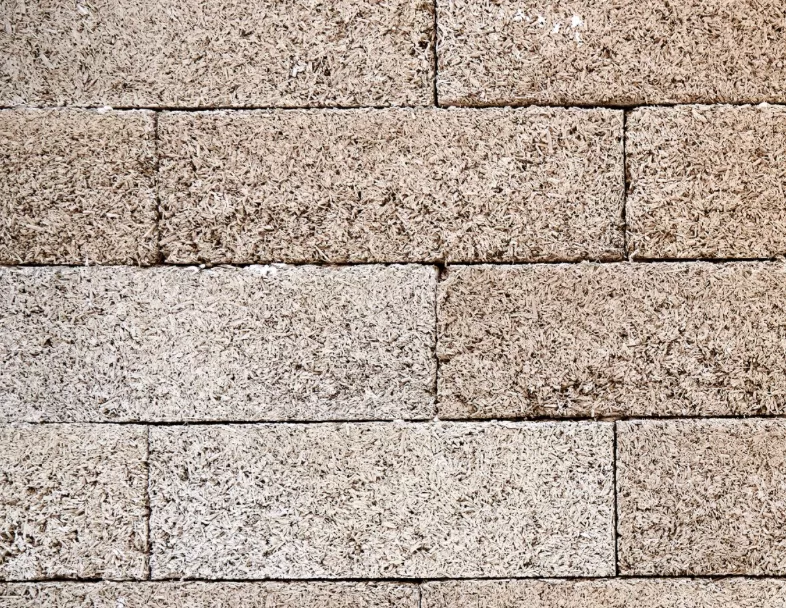
Thermal diffusivity and effusivity: two physical quantities, rarely featured in the sector's commercial discourse, that nonetheless directly determine the comfort felt inside a building.
Thermal diffusivity.
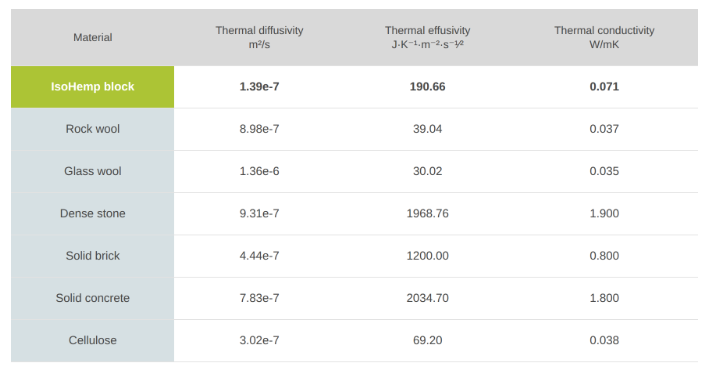
Thermal diffusivity expresses the speed at which a temperature change spreads through a material. It depends on three parameters: thermal conductivity, mass thermal capacity and density. The lower it is, the longer heat takes to pass through the wall. The IsoHemp hempcrete block has a diffusivity of around 1,4 × 10⁻⁷ m²/s, a value 6 to 10 times lower than that of a standard brick or concrete. It is this slowness, not just the thickness of the wall, that explains the material's naturally high phase shift.
Thermal effusivity.
Thermal effusivity, meanwhile, expresses a material's capacity to exchange heat with the surrounding air. It governs the surface temperature of a wall, and therefore how cold or warm it feels to the touch. The IsoHemp block sits at around 190 J·K⁻¹·m⁻²·s⁻¹ᴟ², an intermediate value between lightweight insulants, which have low effusivity, and massive materials such as stone or concrete, which have high effusivity.
The combination of the two.
It is the combination of the two that makes the material distinctive. Low diffusivity delays the arrival of heat; moderate effusivity avoids both the cold-wall effect of lightweight insulants and the excessive thermal inertia of massive materials, which react too slowly to heating needs in winter.
The hempcrete block does not have to choose between summer comfort and winter comfort: its physics lets it deliver both.
On site.
On site, this combination produces two concrete effects that work in opposite directions depending on the season.
In summer, peak outdoor heat only reaches the inside of the building late at night, once outdoor temperatures are already falling: daytime overheating is defused before it is even felt.
In winter, this same slowness limits heat losses and stabilises the indoor temperature, even after the heating has been switched off.
Comparison with other materials.
In summary.
The thermal comfort of a building therefore cannot be reduced to a single conductivity figure (λ = 0,071 W/mK for the IsoHemp block). It is built on the interaction between insulation, thermal inertia, diffusivity and effusivity, four parameters that, taken separately, only tell part of the story.
Going further
For the complete technical data on the hempcrete block range, the Naturally Efficient brochure brings together all performance figures by thickness.